8-leg jacket | 300 ft (91 m) water | platform rig | dry trees | 96 POB
Fixed drilling and production platform
A manned drilling and production platform on an eight-leg steel jacket in about 300 ft of water on the U.S. Gulf of Mexico shelf. A platform rig on the drilling deck, its derrick reaching about 290 ft above the sea, drills new wells while the platform produces. Wells come up through conductors inside the jacket to dry trees on the cellar deck; separators, gas dehydration and compression clean the oil and gas before they leave by pipeline; gas turbines make the power; quarters for 96 people and a helideck sit at the far end from the wells.
Open this facility in 3DAll facilities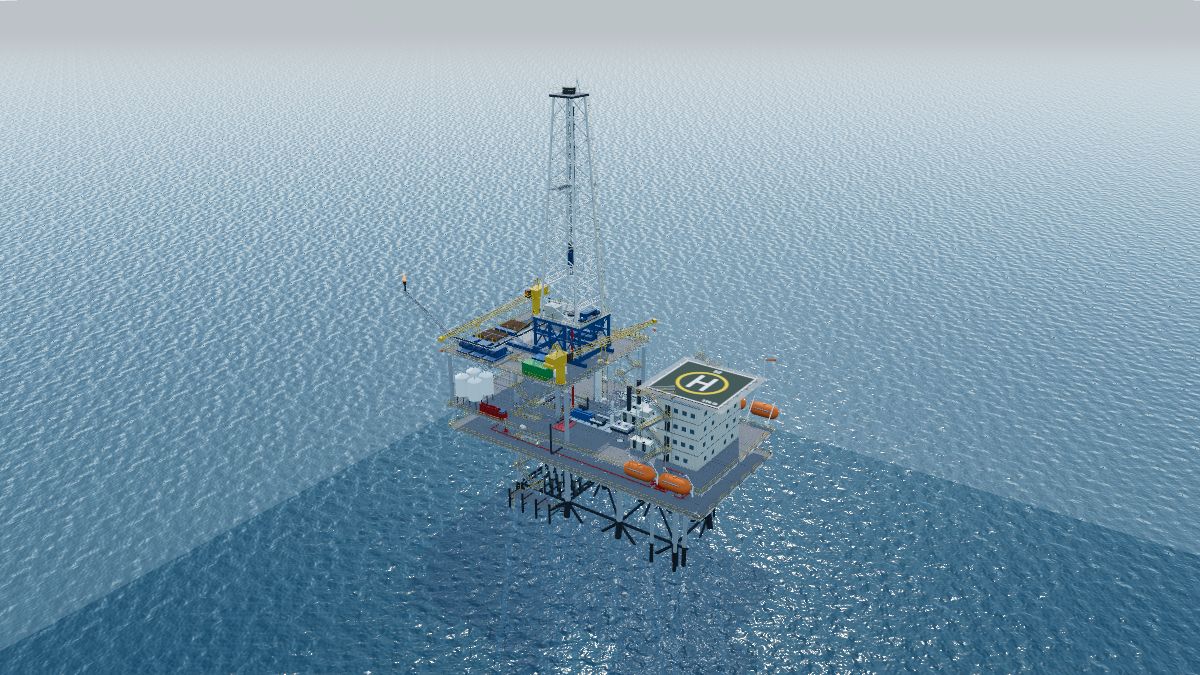
How it is arranged
Generic facility for training. It is not a real platform, field or operator. Structure sizes sit inside ranges reported for eight-leg Gulf of Mexico jackets in BSEE-funded assessment reports; process sizes are worked out for about 15,000 barrels of oil and 75 million standard cubic feet of gas a day and are model values. Drilling equipment sizes come from Gulf of Mexico platform rig specification sheets and BOEM plan attachments for Pacific OCS platform rigs where the part says so; deck sizes are close to those the trade press reports for a Gulf of Mexico drilling and production platform.
Walk through it
The guided tour in the trainer stops at each of these, highlights the equipment and explains it.
- This is a manned drilling and production platform in about 300 ft of water. Under the waterline a steel jacket stands on the seabed: eight legs leaning outward, tied together by X-braces and horizontal framing. X-ray is on so you can see below the sea.
- A steel pipe pile is driven down through each leg about 250 ft into the seabed. The piles pin the platform down and carry its weight; the gap between pile and leg is grouted.
- Twelve conductor pipes come up through the 18-slot well bay, held in line by guide frames at every jacket level. Nine are producing wells, one is being drilled and two are ready for the next wells.
- The platform rig sits on the drilling deck over the well bay. Its derrick stands 147 ft above the drill floor, so the crown block is about 290 ft above the sea. The traveling block and top drive hang from the crown and lift the whole drill string.
- The drill floor is about 28 ft above the drilling deck, high enough for the BOP stack underneath. The driller works the rig from the cabin here, and an ESD station for the production system is near the driller’s console (30 CFR 250.723(b)). The rig skids along its beams to reach each slot; while it moves, every producible well in the affected well bay is shut in, below the surface and at the wellhead (30 CFR 250.723(c)).
- On the well being drilled the BOP stack sits on the casing head: an annular, a blind-shear ram and two pipe rams, the minimum 30 CFR 250.733(a) sets for a surface stack. The diverter above it can send a shallow gas flow overboard through its vent lines.
- The BOP closing unit stores hydraulic fluid under nitrogen pressure, enough to close the BOPs with the rig power off. There are two full BOP control stations, one of them on the rig floor (30 CFR 250.735(c)).
- If the well kicks, the crew shuts it in and circulates the influx out through the choke line and this choke manifold, holding back pressure on the well. The returns go to the mud gas separator, which vents the gas high.
- Three triplex mud pumps send drilling mud up the standpipe, through the rotary hose and the top drive and down the drill string. The mud cools the bit, carries the cuttings up and holds the formation pressure back.
- Returning mud crosses the shale shakers, which screen out the cuttings, then goes back to the pits. The pit volume, the return flow and the gas in the returns show on the drill floor, with a pit level alarm (30 CFR 250.457): a pit gain means the well may be flowing.
- On the cellar deck each well ends in a dry tree: a stack of valves you can walk up to. Master valves, the wing valve and the choke control the flow; the swab valve on top lets wireline crews into the well.
- The red actuator works the surface safety valve. Control pressure holds it open; any shutdown vents that pressure and a spring closes it within 45 seconds. A second valve, the SCSSV, sits at least 100 ft below the mudline and closes after it.
- The wellhead control panel holds every SSV and SCSSV open with hydraulic pressure. Every shutdown signal on the platform ends here, by venting a pilot.
- Flowlines from the wells meet at the manifold. Each well can be lined up to the production header or, one at a time, to the test header for its well test.
- The production separator splits the well stream into gas, oil and water by gravity. Its level and pressure trips, and a relief valve on top, protect it if the controls fail.
- If the pressure ever reaches the vessel’s design limit, this relief valve opens and sends the gas into the relief header, to the knockout drum and the flare.
- The flare burns relieved and blown-down gas at the end of a 100 ft boom, far enough out that the heat stays off the decks. Its pilots stay lit.
- The tall tower is the glycol contactor. Wet gas rises through trays against triethylene glycol, which soaks up the water so the gas will not form hydrates in the pipeline.
- The flash gas compressor takes gas that flashes off at low pressure and squeezes it back up to sales pressure, so it is sold instead of flared.
- The heater-treater warms the oil so the last water drops out. It is a fired vessel, with a burner, a flame arrestor and its own shutdowns.
- Sales oil is measured and sampled in the LACT unit, then the export pumps push it into the pipeline.
- Each export pipeline riser has a shutdown valve at the top. The ESD system closes it, so a fire on the platform cannot draw on the pipeline’s inventory. A departing pipeline is also protected by high- and low-pressure sensors (30 CFR 250.1004(b)(3)).
- Produced water is cleaned in hydrocyclones and this gas flotation unit, then goes overboard through the disposal caisson within the federal oil and grease limits.
- A remote-mounted flow transmitter: stainless impulse tubing runs from the orifice taps up to a five-valve manifold, all inside a heated box so no liquid or hydrate forms in the sensing lines.
- Power and instrument cables run in aluminum ladder trays, kept apart from each other and from any tubing. Short drops to motors and instruments in classified areas are rigid conduit with seals.
- Two gas turbine generators make the power at 4,160 V; one runs and one stands by. The emergency diesel generator and the UPS keep the safety systems alive if both stop.
- Red ESD stations at every stair, boat landing and the helideck shut in the whole platform. Gas and flame detectors, a fusible loop and a deluge ring guard the wells.
- The quarters for 96 people, four levels with the helideck on top, are at the far end from the wells, the rig and the process, behind a fire wall.
- Four enclosed 50-person lifeboats hang on davits, two on each side, so the boats on either side hold everyone on board. Your muster station is next to your boats; liferafts and ring buoys back them up.
- Two stair towers at opposite corners run from the main deck down to the boat landings and a ladder to the water: the two primary means of escape the Coast Guard requires. The drilling deck has two stairs of its own, at opposite ends.
- Two pedestal cranes lift cargo between the supply boats and the decks. Booms rest in their cradles when not in use. That is the tour; try Walk the platform or open the drawings next.
Equipment on this facility
Each item links to its entry in the equipment reference. In the trainer, click any of them to see what it does, its ratings and its safety note.
Barge bumper × 2Boat landing × 3Deck framing × 3Deck grating × 5Deck leg × 2Deck plate × 1Disposal caisson × 1Jacket brace × 1Jacket leg × 1Mudmat × 1Pile × 1Pump caisson × 2Sacrificial anode × 1Sea surface × 1Seabed (mudline) × 1Skid base × 2Stair × 8Sump pile × 1Vessel platform × 1Water column × 1Conductor guide framing × 1Dry tree (Christmas tree) × 9Production choke × 9Surface safety valve (SSV) × 9Well conductor × 1Wellhead × 10Burner and flame arrestor × 1Exhaust stack × 3Flare knockout drum × 1Fuel gas filter × 2Fuel gas heater × 1Fuel gas scrubber × 1Gas flotation unit × 1Gas scrubber × 1Glycol contactor × 1Glycol filter × 2Glycol reboiler × 1Glycol surge drum × 1Heater-treater × 1Hydrocyclone × 2Separator × 2Still column × 1Test separator × 1Air-cooled heat exchanger × 1Charge pump × 2Glycol pump × 2Instrument air package × 1Oil export pump × 2Reciprocating compressor package × 1Water maker × 1Check valve × 9Control valve × 3Flowline × 18LACT unit × 1Manual valve × 18Pig launcher × 2Pipeline × 2Pipeline riser × 2Pressure safety valve (PSV) × 3Process piping × 57Relief and flare piping × 5Riser clamp × 2Shutdown valve (SDV) × 3Chemical injection skid × 1Control tubing × 10Differential pressure transmitter × 1Heated instrument enclosure × 1Impulse tubing × 1Instrument stand × 1Level transmitter (guided wave radar) × 2Magnetic level gauge × 2Orifice meter × 1Pressure transmitter × 2Process control panel × 1Temperature transmitter × 1Wellhead control panel × 1Combustible gas detector × 6Deluge system × 1Deluge valve × 1ESD station × 9Eyewash station × 1Fire and gas panel × 1Fire hose reel × 3Fire wall × 2Fire water main × 4Fire water monitor × 1Fire water pump × 2Flame detector × 3Flare boom × 1Flare tip × 1Fusible plug loop (TSE) × 1Guard rail × 36Inflatable liferaft × 2Ladder to the water × 2Lifeboat (survival craft) × 4Lifeboat davit × 4Muster station × 2Obstruction light × 1Ring life buoy × 4Riser guard × 2Safety shutdown panel × 1Sound signal × 1AC and DC distribution panels × 1Battery bank × 1Dry-type transformer × 2Emergency diesel generator × 1Gas turbine generator × 2Medium-voltage switchgear × 1Motor control center (MCC) × 1UPS rectifier and charger × 1Cable tray × 9Cable tray fitting × 16Conduit and tubing supports × 29Field junction box × 3Instrument cable × 5Multi-cable transit × 13Pipe supports × 41Power cable × 23Rigid conduit × 26Boom rest × 2Cargo basket × 1Cargo container × 2Helideck × 1Laydown area × 1Pedestal crane × 2Tote tank × 2Electrical building × 1Living quarters × 4BOP closing unit (accumulator) × 1BOP stack × 1Bulk tanks × 2Catwalk and V-door ramp × 1Choke manifold × 1Derrick × 1Drawworks × 1Drill floor and substructure × 1Driller’s cabin × 1Mud gas separator × 1Mud pits × 1Mud pump × 3Pipe deck and racks × 2Rig power module × 1Rig skid beams × 1Shale shakers × 1Top drive and traveling block × 1
A generic facility built to typical U.S. Gulf of Mexico practice for training. It is not a real platform, field or operator, and ratings are representative values, not design values.